Lloyd Green said...
Moderators: Dave Mudgett, Brad Bechtel
-
erik
- Posts: 2018
- Joined: 7 Mar 2000 1:01 am
- State/Province: -
- Country: United States
Lloyd Green said...
(on <a href=http://www.geocities.com/Nashville/1962>this</a> web site) that he recorded most instrumentals in a sharp or flat key to avoid bothersome overtones. Can someone explain this, and does it apply to a 6-string guitar also?
-
Guest
You probably know that, on a regular guitar, you can play harmonics on certain frets by lightly touching the string as you pluck it.
Well, on a steel guitar, the bar produces those harmonics naturally, and it's damn hard to get rid of them, as Lloyd notes. One way to avoid them is to play in a key where the main chords do not fall on the frets that produce strong harmonics. I think that's what Lloyd is talking about.
Another way would be to tune the steel to a key that is not used frequently -- like F# -- then when you play in the key of C or G, you're not going to get those harmonics.
Anybody, if I've got this wrong, please correct me.
Well, on a steel guitar, the bar produces those harmonics naturally, and it's damn hard to get rid of them, as Lloyd notes. One way to avoid them is to play in a key where the main chords do not fall on the frets that produce strong harmonics. I think that's what Lloyd is talking about.
Another way would be to tune the steel to a key that is not used frequently -- like F# -- then when you play in the key of C or G, you're not going to get those harmonics.
Anybody, if I've got this wrong, please correct me.
-
Bobby Lee

- Site Admin
- Posts: 14863
- Joined: 4 Aug 1998 11:00 pm
- Location: Cloverdale, California, USA
- State/Province: -
- Country: United States
The harmonics "problem" is most often caused by the back of the string ringing out behind the bar. The effect is most pronounced at harmonic points like the 5th, 7th and 12th frets. It is particularly bad at the 4th fret, where a harmonic lies close to, but not exactly on the fret.
Some builders design the keyhead so that the length of string between the key and the nut is a integer fraction of the scale length. This increases sustain at the harmonic frets, whether the string behind the bar is ringing or not.
The combination of these two factors (behind the bar and behind the nut) causes different harmonic content at the various fret positions. I imagine that Lloyd Green with his keen ear knows which positions provide the most even tones, and picks his keys accordingly.
The keyhead problem, by the way, is solved by keyless tuners. Some people like the even sound of a guitar with a keyless head. Others prefer the rich but less balanced sound of a traditional headstock.
The traditional country sound incorporates the harmonic differences generated by the head of the guitar. It really does add a dimension to the tone, and that dimension changes as you move the bar. A keyless guitar, on the other hand, has a more predictable harmonic content from one fret to the next.
------------------
<small><img align=right src="http://b0b.com/b0b.gif" width="64" height="64">Bobby Lee - email: quasar@b0b.com - gigs - CDs
Sierra Session 12 (E9), Williams 400X (Emaj9, D6), Sierra Olympic 12 (F Diatonic) Sierra Laptop 8 (D13), Fender Stringmaster (E13, A6)
Some builders design the keyhead so that the length of string between the key and the nut is a integer fraction of the scale length. This increases sustain at the harmonic frets, whether the string behind the bar is ringing or not.
The combination of these two factors (behind the bar and behind the nut) causes different harmonic content at the various fret positions. I imagine that Lloyd Green with his keen ear knows which positions provide the most even tones, and picks his keys accordingly.
The keyhead problem, by the way, is solved by keyless tuners. Some people like the even sound of a guitar with a keyless head. Others prefer the rich but less balanced sound of a traditional headstock.
The traditional country sound incorporates the harmonic differences generated by the head of the guitar. It really does add a dimension to the tone, and that dimension changes as you move the bar. A keyless guitar, on the other hand, has a more predictable harmonic content from one fret to the next.
------------------
<small><img align=right src="http://b0b.com/b0b.gif" width="64" height="64">Bobby Lee - email: quasar@b0b.com - gigs - CDs
Sierra Session 12 (E9), Williams 400X (Emaj9, D6), Sierra Olympic 12 (F Diatonic) Sierra Laptop 8 (D13), Fender Stringmaster (E13, A6)
-
Tom Jordan
- Posts: 547
- Joined: 1 Feb 2002 1:01 am
- Location: Wichita, KS
- State/Province: -
- Country: United States
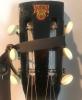
"Peg-head" harmonics...I learned this trick from inspecting Jay Dee's Emmons; use stripped wire (12 guage-ish) as a dampner. I stripped out 3" sections wire and run the strings through it between the nut and the tuning peg.
On my Sierra. the distance from the nut to pegs 6 & 7 is significant to produce a noticable over tone enen while blocking properly. The vibration from the guitar is enough to do this. I insulte the middle six strings and dont' have to worry about it now.
Foam strips would do the trick but colored wire looks nicer.
Thanks Jay Dee!
Tom Jordan
On my Sierra. the distance from the nut to pegs 6 & 7 is significant to produce a noticable over tone enen while blocking properly. The vibration from the guitar is enough to do this. I insulte the middle six strings and dont' have to worry about it now.
Foam strips would do the trick but colored wire looks nicer.
Thanks Jay Dee!
Tom Jordan
-
Larry Petree
- Posts: 605
- Joined: 31 Oct 2000 1:01 am
- Location: Bakersfield. Ca. USA
- State/Province: -
- Country: United States
Peg head harmonics.
Another way to get rid of those harmonics is, strech a rubber band from key shaft #1 over the strings and put it on string #10 key shaft. I have been doing this for years and it really works, and is easy to do. You probably have an unlimited supply on your morning newspaper. Try it, you may like it.
Another way to get rid of those harmonics is, strech a rubber band from key shaft #1 over the strings and put it on string #10 key shaft. I have been doing this for years and it really works, and is easy to do. You probably have an unlimited supply on your morning newspaper. Try it, you may like it.
-
Henry Matthews

- Posts: 4071
- Joined: 7 Mar 2002 1:01 am
- Location: Texarkana, Ark USA
- State/Province: -
- Country: United States
-
Tom Jordan
- Posts: 547
- Joined: 1 Feb 2002 1:01 am
- Location: Wichita, KS
- State/Province: -
- Country: United States
Henry,
I must confess that I can't hear those over tones when playing live. Drum kits have a way of covering those things up. It is very appearant while listening to an isolated recording track...all you hear is your creation, tuning and residual noise!
--Larry your rubber band idea is just to simple! I actually do that on my tele...I've just been too lazy to install an additional string bracket. Strings 3 & 4 can really sing to you if they are not damped.
Tom Jordan<FONT SIZE=1 COLOR="#8e236b"><p align=CENTER>[This message was edited by Tom Jordan on 03 July 2002 at 11:27 AM.]</p></FONT>
I must confess that I can't hear those over tones when playing live. Drum kits have a way of covering those things up. It is very appearant while listening to an isolated recording track...all you hear is your creation, tuning and residual noise!
--Larry your rubber band idea is just to simple! I actually do that on my tele...I've just been too lazy to install an additional string bracket. Strings 3 & 4 can really sing to you if they are not damped.
Tom Jordan<FONT SIZE=1 COLOR="#8e236b"><p align=CENTER>[This message was edited by Tom Jordan on 03 July 2002 at 11:27 AM.]</p></FONT>
-
Bruce Clarke
- Posts: 129
- Joined: 3 May 2001 12:01 am
- Location: Spain
- State/Province: -
- Country: United States
Bobby --thanks for explaining an aspect of the steel that had never even occurred, or been pointed out, to me. It probably goes some way to explaining why (to my ears) Lloyd green gets different tones on certain songs. For example "Moon River" and "Feelings" from his "Steels the hits" CD seem to me to be subtly different tone-wise.I had begun to think that maybe it had something to do with where on the neck he chose to play a given phrase. Do you think that this overtones business reinforces that theory?
-
erik
- Posts: 2018
- Joined: 7 Mar 2000 1:01 am
- State/Province: -
- Country: United States


-
Leroy Riggs
- Posts: 1851
- Joined: 11 Jan 2001 1:01 am
- Location: Looney Tunes, R.I.P.
- State/Province: -
- Country: United States
-
Ted Solesky
- Posts: 660
- Joined: 15 May 2002 12:01 am
- Location: Mineral Wells, Texas, USA
- State/Province: Texas
- Country: United States
When started playing pedal steel, I was using a Fender 1000. It was a nightmare on the the high G#. I heard that some of the pro's were tunning down to a D. So, I ended up tunning to Eb. I got used to it and I'm am still down to an Eb. It really helps when you work with singers that sing in A or E or D. It makes it tough for guys who want to sit in and use my guitar. I don't recommend this. I have been told that this setup does affect my tone.