I’m wondering if on a modern guitar (like a Mullen Discovery, for instance) would it put an unreasonable amount of strain on the changer to make this change:
F#
D#
G#
E
B……C# + +
G#
F#
E…...D - -
D…...B - - -
B…….G# - - -
I’m asking as I’d like to have an S-10 that is under 50 lbs in the case that would do all the usual E9 stuff but also have a lower “E13” type voicing for 40s-50s style Western Swing. This would probably be “pedal zero,” to the left of pedal one. Floppy low strings aside, would a modern guitar be able to handle this big of a change mechanically in a reliable, usable type of way?
Lowering low strings on E9 for Western swing…
Moderator: Dave Mudgett
-
Chris Scruggs
- Posts: 815
- Joined: 20 Jan 2003 1:01 am
- Location: Nashville, Tennessee, USA
- State/Province: Tennessee
- Country: United States
-
Ricky Davis

- Posts: 11519
- Joined: 4 Aug 1998 11:00 pm
- Location: Rocky Top Ranch, Bertram, Texas USA and Liberty Hill, Tx
- State/Province: Texas
- Country: United States
Chris; it would be just a matter of String gauge change and some "Spring Technique". I would put:
[tab]
5th string is .018p
8. .034w >E to D
9. .038w >D to B
10 .042w >B to G#
[/tab]
Take raise springs off those last 3 fingers. If there is adjustable lower return spring....just give them 3 a turn clockwise tighter.
And yes; modern pedal steels can handle this change no prob. If you do it; I would need to see the changer finger move upside down; to tell if timing can be perfected.
Oh what do you mean with that 5th string B to C# + +
What does that plus plus mean and how???
Ricky
[tab]
5th string is .018p
8. .034w >E to D
9. .038w >D to B
10 .042w >B to G#
[/tab]
Take raise springs off those last 3 fingers. If there is adjustable lower return spring....just give them 3 a turn clockwise tighter.
And yes; modern pedal steels can handle this change no prob. If you do it; I would need to see the changer finger move upside down; to tell if timing can be perfected.
Oh what do you mean with that 5th string B to C# + +
What does that plus plus mean and how???
Ricky
Ricky Davis
Email Ricky: sshawaiian2362@gmail.com
Email Ricky: sshawaiian2362@gmail.com
-
Ricky Davis
- Posts: 11519
- Joined: 4 Aug 1998 11:00 pm
- Location: Rocky Top Ranch, Bertram, Texas USA and Liberty Hill, Tx
- State/Province: Texas
- Country: United States
Ok and found a changer pic of Mullen D.
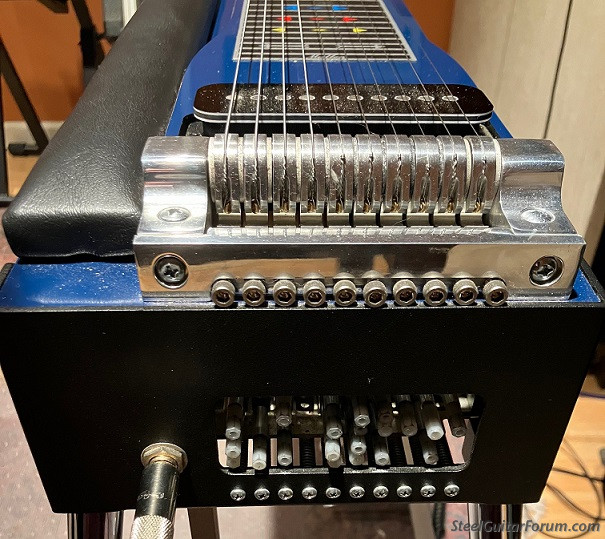
Ok; looks like there is adjustable lower return springs and those are the little phillips screws at bottom of window.
Now those allen bolts behind the changer fingers above window; are "split tune" screws...you have to make sure those last three are screwed out enough that when finger lowers further than normal; the finger won't hit it...yeeehaaaa.
and at least triple raise/double lower fingers require; and looks like yes indeed on this Mullen.
Ricky
Ok; looks like there is adjustable lower return springs and those are the little phillips screws at bottom of window.
Now those allen bolts behind the changer fingers above window; are "split tune" screws...you have to make sure those last three are screwed out enough that when finger lowers further than normal; the finger won't hit it...yeeehaaaa.
and at least triple raise/double lower fingers require; and looks like yes indeed on this Mullen.
Ricky
Ricky Davis
Email Ricky: sshawaiian2362@gmail.com
Email Ricky: sshawaiian2362@gmail.com
-
Chris Scruggs
- Posts: 815
- Joined: 20 Jan 2003 1:01 am
- Location: Nashville, Tennessee, USA
- State/Province: Tennessee
- Country: United States
Ricky, I’d still have ABC on my other three floor pedals, would that .042 be under unreasonable strain then when I raise it to C# with the A pedal? I was assuming .038 would be the best compromise gauge for raising to C# and lowering to G#.
My reasoning for considering this change, and with 5 raising to C#, is I’m wanting to get an E13 tuning with some deeper low end out of an S10 E9. You can get some E13 type sounds with just the A pedal but the low end isn’t there. Especially once 10 raises to C# along with 5. As an example of what I’d gain, I could play Boot Heel Drag in the key of A on a man E9 S10 with this as the 4th pedal.
I could just raise 5 a step and lower 10 a step and a half, but I like the color of omitting the tonic down low and lowering 8, 9 and 10 (4-10 would then give the same voicing as 3-9 on C6 with 5 and 7 mashed).
I’m trying to find a way I could do all the typical E9 ABC stuff without losing anything and then have this as a fourth pedal to get C#min/E13 type voicings (Speedy West, Noel Boggs, Alvino Ray type of sounds).
Of course I’d also still have the B6 option with lowering the Es and A6 voicing of playing with A+B down for older country/swing as well.
just looking for a way to squeeze the most juice out of an orange, I suppose.
My reasoning for considering this change, and with 5 raising to C#, is I’m wanting to get an E13 tuning with some deeper low end out of an S10 E9. You can get some E13 type sounds with just the A pedal but the low end isn’t there. Especially once 10 raises to C# along with 5. As an example of what I’d gain, I could play Boot Heel Drag in the key of A on a man E9 S10 with this as the 4th pedal.
I could just raise 5 a step and lower 10 a step and a half, but I like the color of omitting the tonic down low and lowering 8, 9 and 10 (4-10 would then give the same voicing as 3-9 on C6 with 5 and 7 mashed).
I’m trying to find a way I could do all the typical E9 ABC stuff without losing anything and then have this as a fourth pedal to get C#min/E13 type voicings (Speedy West, Noel Boggs, Alvino Ray type of sounds).
Of course I’d also still have the B6 option with lowering the Es and A6 voicing of playing with A+B down for older country/swing as well.
just looking for a way to squeeze the most juice out of an orange, I suppose.
-
Dennis Detweiler
- Posts: 3942
- Joined: 8 Dec 1998 1:01 am
- Location: Solon, Iowa, US
- State/Province: Iowa
- Country: United States
-
Ricky Davis
- Posts: 11519
- Joined: 4 Aug 1998 11:00 pm
- Location: Rocky Top Ranch, Bertram, Texas USA and Liberty Hill, Tx
- State/Province: Texas
- Country: United States
Well I totally understand Chris and you are getting a lot of juice from that orange....heck yes.
Back in the day; my best friend and teacher: Gary Carpenter, used to put .042 for 10th string; just as a bigger sound at that low string. There's no extra stress...I played that string because he did for a while and loved it. No extra stress at all...and it would be more stable raising and lowering that much.
You're on it man....I love the way you're thinking.
Ricky
Back in the day; my best friend and teacher: Gary Carpenter, used to put .042 for 10th string; just as a bigger sound at that low string. There's no extra stress...I played that string because he did for a while and loved it. No extra stress at all...and it would be more stable raising and lowering that much.
You're on it man....I love the way you're thinking.
Ricky
Ricky Davis
Email Ricky: sshawaiian2362@gmail.com
Email Ricky: sshawaiian2362@gmail.com
-
Dennis Detweiler
- Posts: 3942
- Joined: 8 Dec 1998 1:01 am
- Location: Solon, Iowa, US
- State/Province: Iowa
- Country: United States
I toyed with the idea of buying a S-10. My idea was to change the bottom 3 strings from: E, D, B to:
E
B +++ D raise to D with knee that lowers 2nd string
G# + with B pedal and lower 6 and 10 to F# with a knee
Fat bottom end B6/A6
Floor to raise 5 and 6 a whole tone.
Floor to split 4 and 8
E
B +++ D raise to D with knee that lowers 2nd string
G# + with B pedal and lower 6 and 10 to F# with a knee
Fat bottom end B6/A6
Floor to raise 5 and 6 a whole tone.
Floor to split 4 and 8
1976 Birdseye U-12 MSA with Telonics 427 pickup, 1975 Birdseye U-12 MSA with Telonics X-12 pickup, Revelation preamp, Ibanez Analog Mini Delay and Hall Of Fame Reverb, Crown XLS 1002, 2- 15" Eminence Wheelhouse speakers, ShoBud Pedal, Effects Pedals. 1949 Epiphone D-8.
-
John Poston
- Posts: 635
- Joined: 7 Apr 2004 12:01 am
- Location: Albuquerque, NM, USA
- State/Province: -
- Country: United States
-
Fred Treece

- Posts: 4789
- Joined: 29 Dec 2015 3:15 pm
- Location: California, USA
- State/Province: California
- Country: United States
I was thinking S12 E9. With E and G# on strings 12 and 11, the only change needed to get the tuning Chris has in mind (plus E on string 8 between D and F# - which may not be desirable) is an isolated B>C# on string 5 while keeping the low B on string 10 intact.Dennis Detweiler wrote:U-12
Keeping the load under 50lb shouldn’t be a problem with an E9ext. With a U12, it’s a bit more hit and miss.
-
Chris Scruggs
- Posts: 815
- Joined: 20 Jan 2003 1:01 am
- Location: Nashville, Tennessee, USA
- State/Province: Tennessee
- Country: United States
-
Marshall Woodall
- Posts: 76
- Joined: 6 Feb 2022 10:04 pm
- Location: New York, USA
- State/Province: New York
- Country: United States
If you want some low end with a bunch of other useful functionality take a look at Larry Allen's 10 string extended E9 copedent. The bottom 3 strings are tuned E-B-E. The low E 10th string will drop to C# on a lever. The 9th string B will move from A to C# on a pedal and lever combination. Finally the 8th string E (along with 4) moves from F down to D through knee levers (LKL up/RKL down) along with the use of a solid half stop assembly and split screws. Not necessarily a focus on Western swing but I think you can get there along with some nice bottom end. I really like it but I'm coming from a 50 year multi style 6 string guitar approach.
-
Chris Scruggs
- Posts: 815
- Joined: 20 Jan 2003 1:01 am
- Location: Nashville, Tennessee, USA
- State/Province: Tennessee
- Country: United States
I don’t want to modify the standard open E9 tuning, and I really don’t want to lose the 9th string (even if that note would be accessible on a lever). I was pretty much just curious about the reliability and stability of adding a fourth pedal that does what I explained above. A low E can be nice though!
-
Larry Allen

- Posts: 1591
- Joined: 5 Apr 2004 12:01 am
- Location: Kapaa, Kauai,Hawaii
- State/Province: Hawaii
- Country: United States
Coped
Aloha. My 21lb Excel set up has a much used low end, easy to find chords for all genres .. I play lots of swing, jazz, rock and country with it..Larry 

Excel steels & Peavey amps,Old Chevys & Motorcycles & Women on the Trashy Side
-
Fred Treece
- Posts: 4789
- Joined: 29 Dec 2015 3:15 pm
- Location: California, USA
- State/Province: California
- Country: United States
I don’t get how it could be more stable than standard gauge by raising and lowering by those wide intervals. It seems like those thicker gauges would change the stress level on the deck more than normal and effect the tuning. There’s probably a physics principle that I’m missing and is above my pay grade to understand.Ricky Davis wrote:Well I totally understand Chris and you are getting a lot of juice from that orange....heck yes.
Back in the day; my best friend and teacher: Gary Carpenter, used to put .042 for 10th string; just as a bigger sound at that low string. There's no extra stress...I played that string because he did for a while and loved it. No extra stress at all...and it would be more stable raising and lowering that much.
You're on it man....I love the way you're thinking.
Ricky
-
Dennis Detweiler
- Posts: 3942
- Joined: 8 Dec 1998 1:01 am
- Location: Solon, Iowa, US
- State/Province: Iowa
- Country: United States
There's D9th to consider for a heavier bottom. I think Jimmy Day played D9th? I started on D9th and got along well with it in country mode. I moved from D-10 to S-12 and continued for a while with extended D9/D6th. It worked well with 5+5 but didn't have all of the floor changes to complete the pedal chords.
1976 Birdseye U-12 MSA with Telonics 427 pickup, 1975 Birdseye U-12 MSA with Telonics X-12 pickup, Revelation preamp, Ibanez Analog Mini Delay and Hall Of Fame Reverb, Crown XLS 1002, 2- 15" Eminence Wheelhouse speakers, ShoBud Pedal, Effects Pedals. 1949 Epiphone D-8.
-
Ricky Davis
- Posts: 11519
- Joined: 4 Aug 1998 11:00 pm
- Location: Rocky Top Ranch, Bertram, Texas USA and Liberty Hill, Tx
- State/Province: Texas
- Country: United States
yes Fred; with standard gauges and having to let off MORE tension to Lower that much is mainly what I'm talking about and have ALREADY found out by doing exactly what Chris wants to do. It is the back and forth Raise and Lower change in tension to the string; is the stability I'm talking about. Then I described the springs that are there or NOT and spring tension that helps the difference in raise and lower tension going on with a Finger. I did this on a 24" scale 2/2 changer Sho~Bud; so NO I haven't tested it on any other Steel.
Ricky
Ricky
Ricky Davis
Email Ricky: sshawaiian2362@gmail.com
Email Ricky: sshawaiian2362@gmail.com
-
Fred Treece
- Posts: 4789
- Joined: 29 Dec 2015 3:15 pm
- Location: California, USA
- State/Province: California
- Country: United States
Thanks, Ricky, that helps.
I have often wondered about the all-pull changer’s effect on “cabinet drop”. Even though tension on a string is lowered when the pitch is lowered, the changer is still doing a pull on the finger. The physics must be producing some kind of equilibrium, I guess? A pull that produces a raise seems like it would naturally add to drop, because of the pull plus the increased string tension. A change like the one Chris proposes with simultaneous raise and lowers produces more balance than a change that just does one or the other. Is that close?
Sorry for the distraction from your post, Chris! But it has brought up an educational opportunity, so thanks, too.
I have often wondered about the all-pull changer’s effect on “cabinet drop”. Even though tension on a string is lowered when the pitch is lowered, the changer is still doing a pull on the finger. The physics must be producing some kind of equilibrium, I guess? A pull that produces a raise seems like it would naturally add to drop, because of the pull plus the increased string tension. A change like the one Chris proposes with simultaneous raise and lowers produces more balance than a change that just does one or the other. Is that close?
Sorry for the distraction from your post, Chris! But it has brought up an educational opportunity, so thanks, too.
-
Dennis Detweiler
- Posts: 3942
- Joined: 8 Dec 1998 1:01 am
- Location: Solon, Iowa, US
- State/Province: Iowa
- Country: United States
The downward floor pedal pressure on the cabinet should also create some drop? Use your thumb to put downward pressure on the cabinet while watching the tuner.
1976 Birdseye U-12 MSA with Telonics 427 pickup, 1975 Birdseye U-12 MSA with Telonics X-12 pickup, Revelation preamp, Ibanez Analog Mini Delay and Hall Of Fame Reverb, Crown XLS 1002, 2- 15" Eminence Wheelhouse speakers, ShoBud Pedal, Effects Pedals. 1949 Epiphone D-8.
-
Larry Bressington
- Posts: 2818
- Joined: 6 Jul 2006 12:01 am
- Location: Nebraska
- State/Province: Nebraska
- Country: United States
-
Ricky Davis
- Posts: 11519
- Joined: 4 Aug 1998 11:00 pm
- Location: Rocky Top Ranch, Bertram, Texas USA and Liberty Hill, Tx
- State/Province: Texas
- Country: United States
YES indeed Fred; I believe you NAILED it!!!!I have often wondered about the all-pull changer’s effect on “cabinet drop”. Even though tension on a string is lowered when the pitch is lowered, the changer is still doing a pull on the finger. The physics must be producing some kind of equilibrium, I guess? A pull that produces a raise seems like it would naturally add to drop, because of the pull plus the increased string tension. A change like the one Chris proposes with simultaneous raise and lowers produces more balance than a change that just does one or the other. Is that close?
Good on'ya.
Ricky
Ricky Davis
Email Ricky: sshawaiian2362@gmail.com
Email Ricky: sshawaiian2362@gmail.com
-
John Wilson

- Posts: 400
- Joined: 11 Feb 2010 2:56 pm
- Location: Coeur d' Alene, Idaho
- State/Province: Idaho
- Country: United States
JET 10 tuning
Dan Burnham published the JET 10 tuning a while back:
http://www.danburnham.com/jet10-tuning.html
It sort of accomplishes what you want to do.
Perhaps this tuning with a few mods would work for you.
I get the western swing stuff on my E13 tuning:
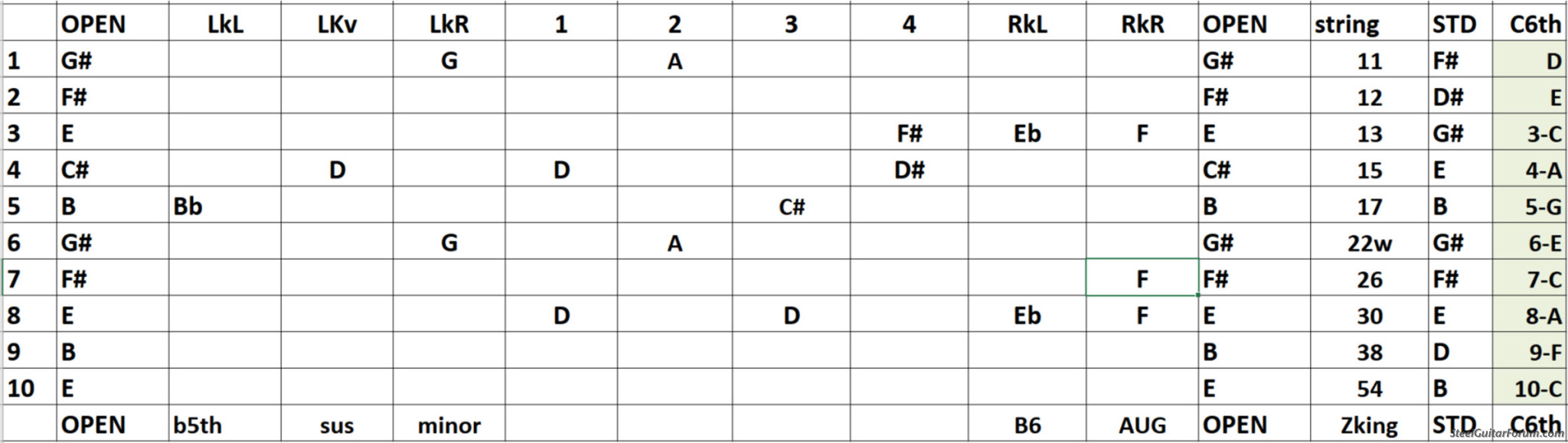
I enjoy your playing BTW.
Best.
http://www.danburnham.com/jet10-tuning.html
It sort of accomplishes what you want to do.
Perhaps this tuning with a few mods would work for you.
I get the western swing stuff on my E13 tuning:
I enjoy your playing BTW.
Best.
Customer: "Waiter, how do you prepare your chicken?"
Waiter: "We usually tell them they're not going to make it."
Waiter: "We usually tell them they're not going to make it."
-
Daniel Baston

- Posts: 144
- Joined: 27 Aug 2018 9:32 am
- Location: Toronto, Ontario, Canada
- State/Province: -
- Country: United States
Re:
I followed this thread with interest when it was current. I was just thinking about tunings and copedents (the curse of a steel player I guess!) and remembered this thread. I hope that this is somewhat on topic... I had an idea for another way to approach this. As with any of this stuff, this idea here would compromise some things and that could end up making it not work for some people. I am curious if there are any thoughts about it.Chris Scruggs wrote: 2 Apr 2023 6:45 pm ...My reasoning for considering this change, and with 5 raising to C#, is I’m wanting to get an E13 tuning with some deeper low end out of an S10 E9. You can get some E13 type sounds with just the A pedal but the low end isn’t there...
Anyway, what if you eliminated the 9th string D? That way you could gain a full time G# in the 10th string spot. Now, to get that D, I think the most logical thing to do would be to lower the 8th string E a whole step. Maybe the same lever that lowers the 2nd string for example? What would be really trick, would be if that lever could also disengage the bottom half of the A pedal change. Or you could get the C# on string 2, but out of sequence (re-entrant).
You would have to be OK with reaching for a lever every time you want to play the D. Other potential issues would be where to put the change and timing it with other pulls (if added to the lever that does the 2nd string lower for example).
Edit: I see that a couple of other people suggested eliminating the D string as well. I guess the difference is that I am proposing a G# on the bottom. Some very interesting ideas in this thread!
You do not have the required permissions to view the files attached to this post.