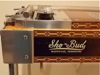
To summarize up front what I achieved:
<font face="monospace" size="3"><pre>
Cents drop before after
4th string 14 9 w/AB
5th string 10 7 w/B
6th string 21 13 w/A
8th string 12 10 w/AB
Cabinet deflection as measured at the 12th fret with a deflection gauge calibrated
at .0001" increments
before after
A pedal .0009 .0005 Lower
B pedal .0006 .0002-.0003 Lower
AB pedals - .0007-.0008 Lower
D lever .0002-.0003 .0000-.0001 Raise (push lever until full lower)
D lever - .0010 Raise (push lever until no more deflection)
F lever .0000-.0001 .0000-.0001 Lower (push lever until full raise)
F lever - .0010 Raise (push lever until no more deflection)
Nut deflection measured in the middle of the nut span with deflection gauge
before after
A pedal - .0001-.0002
B pedal - .0000-.0001
Changer deflection measured in the middle of the changer span with deflection gauge
before after
A pedal - .0001-.0002
B pedal - .0000-.0001
</pre></font>
I was able to lower the "cabinet drop" with my modifications. I do not have nut and changer "before" readings. The second set of D and F lever readings illustrate quite clearly part of my observations in that the stops of the knee levers contact the body of the guitar while the pedal stops do not.
Hypothesis:
I believed that adding tension to the underside of the guitar body to offset the bow effect caused by the raised strings would eliminate cabinet drop.

Methodology:
I disassembled my guitar and laid aside the body and front apron which are glued together. I retained all of the other parts except rods and tuning nuts which I had to change because of the customization.
The body
The new body is a solid piece of Chunkeq, a variety of Central American Mahogany. I chose this piece of wood for its "musical" quality. I spent a lot of time at the local hardwood suppliers looking for the right piece of wood. I wanted a piece of wood that transmitted sound well. I would hold the piece of wood off the floor with my ear to one end. I would then tap the other end with a fingernail. Most of the wood I found was dead or dull sounding. This included the various species of maple and Honduran mahogany as well as other species whose names I don't remember. Only a couple of pieces sounded good. The piece I ended up with was the right size. It is not a particularly strong piece of wood because it can be bent with some pressure but it sounds good, almost bell-like.
The front apron is a piece of Honduran Mahogany that I had in my workshop.

The Tension system
I built the tension system from aircraft aluminum and 1/4" steel rod. I got a couple of blocks of aircraft aluminum from the Boeing surplus store. I cut it to make angle brackets which I drilled for screw holes and tension rod holes. I threaded both ends of the steel rods. The tension rods sit on both sides of the strings. My guitar's end-plate was a 12 string end-plate so I could move the 10 strings over one position to accommodate the tension rods. I put double nuts and lock-washers on the threaded rods.

Detail

Body not connected to the front and back aprons
I made one further modification. I mounted the body to the endplates only. There is no connection between the body and the aprons, pedal rods, etc. except for the changer. The other exception is the knee lever stop-screws which contact the body at the end of the knee lever change.
How does it sound?
The sustain is amazing! The treble notes are clear and bright. The bass notes make the whole guitar vibrate. I can even feel it in the pedal bar. The guitar is a real pleasure to play because it stays in tune.
Did I solve the Cabinet drop problem?
The answer is no. I decreased the amount of cabinet drop but did not eliminate it. I still have "cabinet drop" which I can attribute to the nut and changer. And I still have cabinet deflection.
Karlis
<FONT SIZE=1 COLOR="#8e236b"><p align=CENTER>[This message was edited by Karlis Abolins on 27 August 2002 at 11:45 AM.]</p></FONT><FONT SIZE=1 COLOR="#8e236b"><p align=CENTER>[This message was edited by Karlis Abolins on 27 August 2002 at 01:06 PM.]</p></FONT>