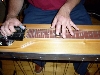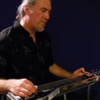
These two videos are from a performance last Saturday (9.28.2013) at the Windup Space in Baltimore. The legendary British free improv saxophonist Evan Parker was here to play with bassist Michael Formanek and myself. As with most free improvisation performances, there was little contact before the gig - ours consisted of a five minute sound check, and an outdoor meal on Baltimore's famed North Avenue (across the street from the motel where Omar and Brother Mouzon had their little shoot-out on "The Wire" - in fact, we were serenaded by several police cars and an ambulance speeding down the street while a helicopter circled overhead - ah, Baltimore!).
I am often asked by musicians (and non-musicians) what "free improvisation" is, and how do we create music without scores, songs, chords, etc, so I will try to give a somewhat incomplete, and hopefully not too misleading explanation of what it is, at least for me.
Basically, when I'm improvising, there are at least four things I try to keep in mind, at least somewhere, in the back of my head: the harmonic and rhythmic aspects, conversation and respect for others on stage, the importance of the music to have a sense of development and themes, and respect for the audience - the responsibility to engender in the audience a meaningful shared musical experience.
For harmonic concepts, it works perhaps a little like this, very simplified - say Evan plays a "C" note. So I have quite a few choices for something to play with that - do I play the same note? a fifth? a tri-tone? a quarter tone? something microtonal? an octave? And what will Mike play? What will Evan or Mike or myself play next? so logically it could go in an almost infinite number of directions (modified my each of our training, abilities, and musical tastes). The same goes with rhythm. Pulse - swing? ballad? extremely fast? the persistent evenness of an electronic pulse (which we in this day and age can't escape (nor can the birds))?
So you have to be really aware and on your toes the whole time. There is always the close possibility of missteps and things that don't work out as well as you'd like, but I guess that's one of the hazards (and beautiful aspects) of jumping into the musical unknown.
Evan is famous for his "sheets of sound" circular breathing approach to saxophone (combined with an often quite tender lyricism), so relating to that characterized much of our meeting. Sometimes you can hear us playing or repeating each other's motifs, and sometimes it sounds like we're playing the exact same notes. At times I wonder who was playing what, not even sure if it was I who made a certain note or sound. And then at other times we're quite distinct, resembling a sort of conversation.
Respect for others means always listening to each other and having a feel for when someone needs space to play solo or with another instrument in an accompanying role - i.e. knowing when to lay out.
Development and themes. I try to have a space in my mind somewhere (an observer from above) of where the musical ideas are going in order to know when and how to move on to another idea or theme. This ties into respect for the audience - without watering down the musicality of what you're doing, always trying to play for the audience, to present a road that will in some way give them a meaningful experience, some insight into those deep places that we all possess and to which we as humans need to be in touch with and return to from time to time. It's an acquired skill and perhaps, like a lot of things, an acquired taste.
So, if you have some patience listening to this without preconceptions, perhaps you can find something that will speak to you in the language of your music, the language of your heart.
Thanks for watching and for listening.
First piece (tenor sax): http://www.youtube.com/watch?v=icJL11Kqbdc
Second piece (soprano): http://www.youtube.com/watch?v=_ZilOSzb ... e=youtu.be